
Criminal law in Australia gives you enforceable rights at every stage, from arrest and police questioning through bail, trial, and sentencing, but they only protect you if you know and use them. 344,620 Australians faced criminal charges in 2024-25. Your response in the first 24 hours can determine your outcome. This complete guide covers your rights at every stage: from arrest through questioning, bail, trial, and sentencing.
Criminal charges are serious. Understanding the system, your protections, and when to engage a lawyer immediately significantly improves outcomes. See our guide on finding a criminal defence lawyer for practical advice on selecting representation.
TL;DR: If you're charged with a crime in Australia, you have the right to remain silent, the right to legal representation, and the presumption of innocence until trial. Criminal courts handle 344,620+ cases annually. Understanding your rights, the bail system, and when to engage a criminal defence lawyer immediately can significantly impact your outcome. This guide covers each stage of the criminal justice system from arrest through sentencing.
What Is Criminal Law in Australia?
Criminal law prosecutes conduct that breaches the Crimes Act (Commonwealth) or State Criminal Codes. Unlike civil disputes, criminal cases pursue public justice. The state (Commonwealth/state) prosecutes; you defend (Commonwealth Director of Public Prosecutions, 2025).
State vs. Commonwealth jurisdiction varies by offence seriousness. Types of offences: summary (dealt with in lower courts, <6 months jail max) and indictable (higher courts, harsher penalties). Culpability standards: intent, recklessness, or negligence determine severity.
Acts intended to cause injury is the most common principal offence in Australia, accounting for 28% of all male offenders proceeded against in 2024-25 (ABS, Recorded Crime Offenders 2024-25).

Your Rights If Charged With or Questioned About a Crime
You have the right to remain silent, the right to legal representation at no cost (if you qualify), and the presumption of innocence. Police cannot compel you to answer questions. This is protected under the Evidence Act 1995 and common law (Evidence Act 1995, 1995).
Cover: Right to silence, legal aid eligibility, right to be informed of charges, notification of family.
Citation Capsule: Your right to silence is a fundamental protection. Any answer can be used in evidence, but silence cannot be used against you (with narrow exceptions). This is protected by the Evidence Act 1995 and common law across all Australian jurisdictions.
As of February 2026, federal hate crime legislation introduced mandatory sentencing up to 7 years, reflecting expanded criminal law scope (Combatting Antisemitism Act 2026).
Understanding the Criminal Justice Process: Arrest to Trial
Criminal proceedings follow a standardised path: police investigation → charging → bail hearing → trial/plea → sentencing. Each stage protects your rights and offers decision points where legal counsel is critical. For a detailed walkthrough of what happens at each stage, see our guide on the criminal process.
Charging decision, initial appearance, bail process, committal hearing (indictable offences), discovery, trial procedures all offer opportunities for your lawyer to protect your interests.
In 2024-25, 11% fewer adult bail grants were approved in Victoria post-March 2024 bail reforms, signalling tougher standards (Magistrates Court of Victoria, 2024).
Police Powers and Your Rights When Stopped or Questioned
Police can stop and question you without a warrant if they suspect you've committed an offence. You're not obliged to answer questions or consent to searches without a lawful warrant-assert your right to silence clearly.
When police can detain you, search powers, warrants vs. consent, caution requirements, recording requirements (state-specific) all matter. Despite broader protest powers granted in 2025-26, the right to silence remains protected-January 2026 court challenges partially overturned Victoria Police's extraordinary designated area powers (Legal Aid NSW, 2026).
For a step-by-step guide on how to handle a police interview, what you must and must not say, and your rights during questioning, see What to Do If Police Want to Question You.
Bail and Remand in Australia
After arrest, you appear before a court for a bail hearing. The court decides whether you can be released (on bail conditions) or remanded in custody pending trial. Bail laws have tightened significantly in 2024-25 across NSW and Victoria.
Bail eligibility, "show cause" offences, conditions (residence, reporting, no contact), remand, appeals, personal vs. surety bail all determine your release outcome. South Australia's breach of bail charges dropped nearly 10% in 2025 (9,317 files in 2025 vs. 10,344 in 2024), reflecting stricter initial bail assessment (Premier of South Australia, 2025).
For a complete breakdown of how bail works, show cause requirements by state, and how to prepare for a bail hearing, see Bail in Australia: How It Works and How to Apply.
Types of Offences and Sentencing
Offences in Australia are classified as summary (dealt with in lower courts, usually <6 months jail max) or indictable (higher courts, harsher penalties). Sentencing depends on culpability, harm, prior history, and statutory guidelines.
Summary vs indictable, aggravating/mitigating factors, sentencing ranges, conviction consequences all affect your outcome. Sexual assault recorded by police reached 40,087 victims in 2024-25, the highest number in the ABS time series, reflecting increased reporting and prosecution priority (ABS Recorded Crime Offenders 2024-25, 2025).
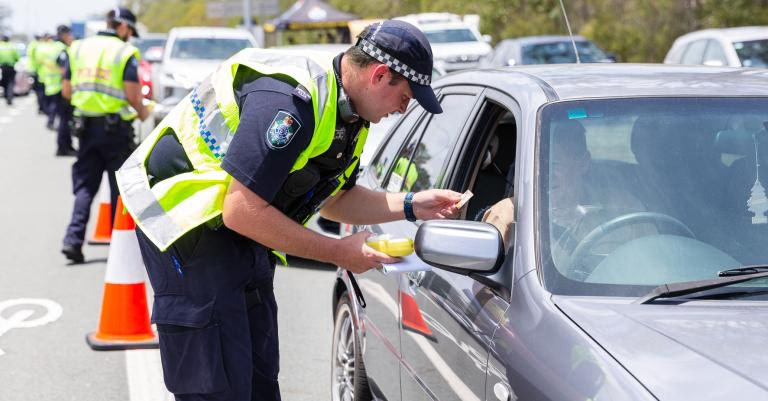
Drink Driving and Traffic Offences
Drink driving is prosecuted as a serious offence in Australia with state-based penalties. Low-range offences carry $1,000-$1,200 fines and 3-6 month licence disqualification; mid-range and high-range offences carry jail time up to 2 years and permanent licence suspension.
BAC limits (0.05 general, 0.00 for learner/P-plates), penalties by BAC range, licence interlock, traffic offence defences all factor in. 2026 drink-driving penalties are increasing-maximum fines jump to $2,204, and on-the-spot penalties of up to $980 roll out for low-to-mid-range offences from early-to-mid 2026 (Andatech 2026 Drink Driving Guide, 2026).
Drink driving accounts for 12.0% of fatal crashes involving risky road behaviour; however, positive breath tests have declined from 0.8% (2020) to 0.6% (2024) (National Road Safety Data Hub, 2024).
For detailed drink-driving penalties and BAC limits by state, see our comprehensive drink-driving penalties guide. For how demerit points, suspension thresholds, and traffic fines vary across states, see our traffic offences and demerit points guide.
When and How to Engage a Criminal Lawyer
Engage a criminal defence lawyer immediately if charged with any indictable offence or if police plan to interview you. For serious summary offences, legal advice before trial significantly improves outcomes. Legal aid is available if you don't qualify for private counsel.
When a lawyer is essential vs. optional, what to look for (experience, legal aid accreditation, court access), legal aid eligibility, cost benchmarks all matter. The Australian legal services industry is projected to reach $35.8 billion in revenue in 2025-26, with criminal law remaining a significant practice area (IBISWorld, 2025).
Common Misconceptions About Australian Criminal Law
Silence is not admission of guilt; silence cannot be used against you. Conviction without trial is not possible (except plea); being charged is not guilt. These misunderstandings often cause defendants to self-incriminate or accept unfavourable deals.
44,583 youth offenders (aged 10-17) were proceeded against in 2024-25, a 5% decrease from 2023-24, indicating effectiveness of diversion and bail reform (ABS Recorded Crime Offenders 2024-25, 2025).
FAQ: Your Rights and Criminal Process
What should I do if I'm arrested?
Immediately request a lawyer and remain silent. Provide only basic identification. Use your right to silence-you do not have to answer questions about the alleged offence. This is protected by the Evidence Act 1995.
Do I have to answer police questions?
No. You have the fundamental right to silence under Australian common law. Police must caution you before questioning that no answer is required and that any answer may be used in evidence. Any statement you make can harm your defence.
What is bail and can I get out of custody?
Bail is release from custody on conditions (e.g., residence, reporting, no contact) pending trial. Courts now apply stricter standards (2024-25 reforms in NSW, Victoria). Whether you're granted bail depends on offence seriousness, criminal history, and "show cause" requirements. Legal representation at the bail hearing improves your chances significantly.
How much does a criminal lawyer cost?
Private fees range from $2,500-$5,000+ for simple matters to $20,000-$50,000+ for trial preparation. Legal aid (free) is available if you qualify on income/assets, but waiting times are significant. Many criminal lawyers offer payment plans. See our detailed breakdown of criminal lawyer costs for current pricing in your state.
What is a conviction and what are the consequences?
A conviction is a formal finding of guilt. It creates a criminal record affecting employment, travel, professional licensing, and future bail decisions. Some convictions can become spent — clearing a criminal record / spent convictions after a crime-free waiting period; eligibility varies by state and offence severity.
Can I get my conviction expunged or appealed?
Appeal rights depend on conviction type and grounds (miscarriage of justice, procedural error, new evidence). Spent conviction schemes exist in most states, but eligibility varies. Some offences cannot be spent (e.g., sexual violence). Seek legal advice within strict appeal timeframes (usually 28-90 days).
What's the difference between a summary and indictable offence?
Summary offences (minor theft, simple assault, low-level drugs) are tried in lower courts with lower penalties (<6 months jail typically). Indictable offences (robbery, serious assault, sex offences) go to higher courts with harsher penalties (years of jail). Some offences are "either way" and can be tried either way depending on circumstances and election.
Conclusion
Criminal charges are serious, but understanding your rights protects you at every stage. Key takeaways:
- Understand your rights: silence, legal representation, presumption of innocence
- Engage a lawyer immediately for indictable offences or serious summary matters
- Bail laws are stricter post-2024 reforms; bail hearings require preparation
- Conviction consequences are lasting; appeal/expungement options exist but are time-limited
- The criminal justice system is complex-don't navigate it alone
If you're facing criminal charges, use Law Firms Australia to find a criminal defence lawyer in your state. Every decision in the first 48 hours affects your outcome. Get advice before speaking to police.
Find a criminal lawyer near you:
- Best Criminal Lawyers in Sydney
- Best Criminal Lawyers in Melbourne
- Best Criminal Lawyers in Brisbane
Related guides:
- If you've been arrested in Victoria, see our first 24 hours guide for Melbourne
- For a detailed step-by-step walkthrough of the charging process, see our criminal process guide
- If police want to question you, see What to Do If Police Want to Question You
- For bail hearing preparation, see Bail in Australia: How It Works and How to Apply
- For demerit point thresholds, double-demerit periods, and traffic fines by state, see Traffic Offences and Demerit Points in Australia