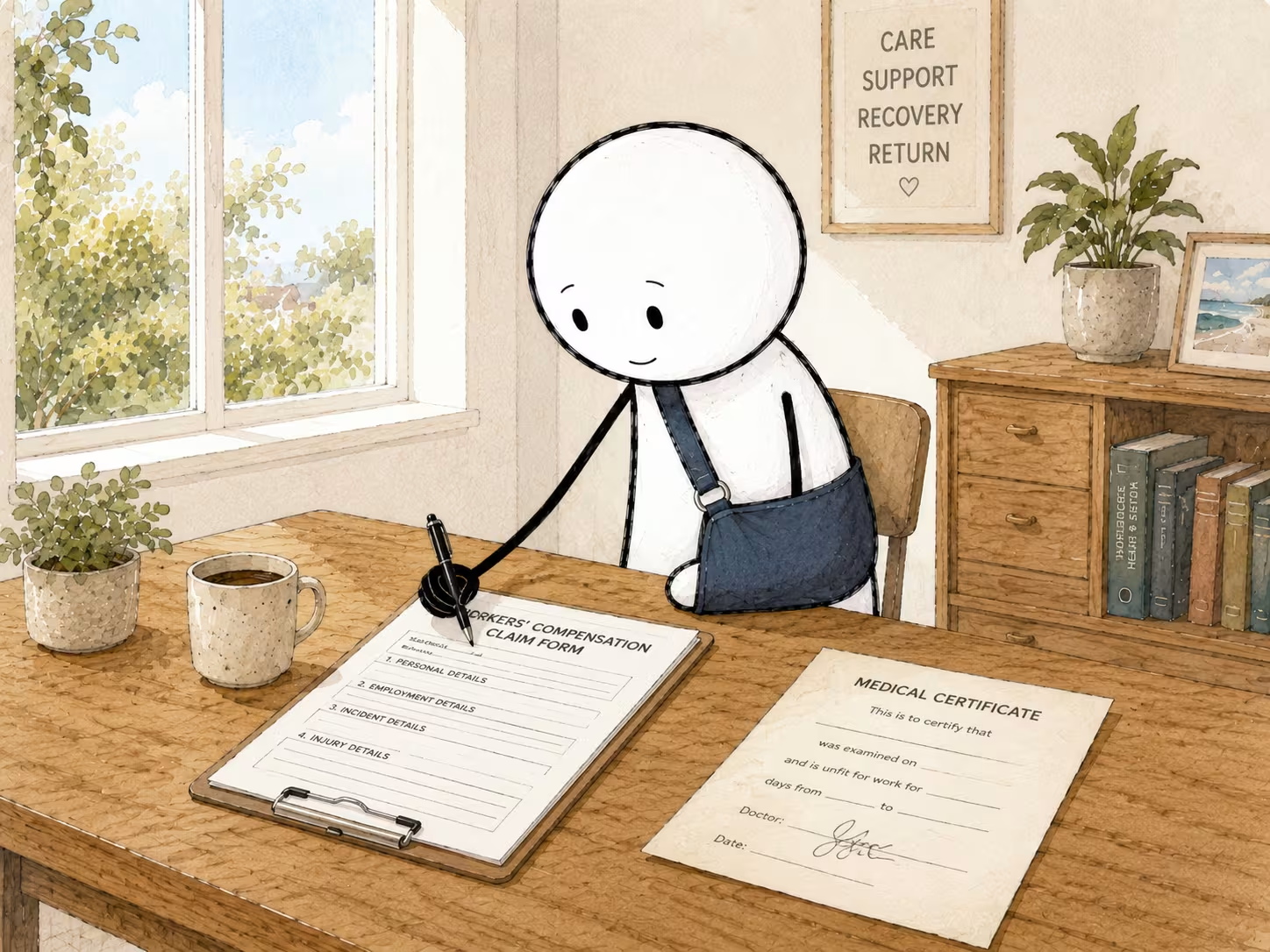
To claim workers' compensation in Australia, notify your employer immediately, get a certificate of capacity from your doctor, complete the claim form, and lodge it with your employer's insurer, generally within six months of the injury. Each state runs its own scheme, so who handles your claim depends on where you work. There were 146,700 serious workers' compensation claims in Australia in 2023–24, more than 400 a day (Safe Work Australia, 2025).
If you have just been hurt at work, the practical questions come fast: what do I do first, who handles my claim, and how long do I have? This guide walks through the claim process step by step, sets out the deadlines that can sink a valid claim, and gives you a single national table of which regulator and insurer covers your state. Not sure where your situation fits? Start with the employment law in Australia complete guide.
TL;DR: To claim workers' compensation in Australia, notify your employer immediately, get a certificate of capacity from your doctor, complete the claim form, and lodge it with your employer's insurer, generally within six months. Each state runs its own scheme (icare/SIRA in NSW, WorkSafe in VIC, WorkCover in QLD/WA), with Comcare covering many federal employees. There were 146,700 serious claims in 2023–24 (Safe Work Australia, 2025).
What Is Workers' Compensation?
Workers' compensation is a no-fault insurance scheme that covers employees for work-related injury or illness, providing medical costs, wage replacement and rehabilitation support (Safe Work Australia, 2025). No-fault means you do not have to prove your employer did anything wrong. You only have to show the injury arose out of, or in the course of, your employment.
The cover is broader than most people assume. It extends to physical injuries, occupational diseases that develop over time, aggravation of a pre-existing condition, and psychological (mental health) injury caused by work. It generally applies to employees, including many casuals and, in most schemes, some deemed workers. Whether you are covered often turns on your classification: genuine independent contractors usually fall outside the scheme, so the line between employee and contractor decides your eligibility. If you were let go around the same time, our guide to unfair dismissal in Australia explains the related protections employees have.
Workers' compensation is a no-fault scheme, so an injured employee can claim medical costs, weekly wage replacement and rehabilitation without proving employer negligence (Safe Work Australia, 2025). Coverage depends on being classified as a worker, which is why contractor status matters so much.
How Do You Make a Workers' Compensation Claim?
The process is essentially five steps: notify your employer, get medical attention and a certificate of capacity, complete the claim form, lodge it with the insurer, and respond to the liability decision (Safe Work Australia, 2025). The order matters, because each step feeds the next.
- Notify your employer as soon as possible: verbally straight away, then in writing. Most schemes require employers to keep a register of injuries.
- See a doctor and get a certificate of capacity (called a certificate of capacity or work capacity certificate). This medical document confirms the injury and your ability to work, and it underpins your weekly payments.
- Complete the claim form for your state's scheme. Your employer or the insurer provides it.
- Lodge the claim with the insurer. Your employer must forward it, but you can lodge directly if they do not.
- Respond to the liability decision. The insurer investigates and decides whether to accept your claim.
Insurers work to set timeframes. In New South Wales, the insurer must acknowledge your claim within roughly seven days and make a liability decision on a standard claim within about 21 days (icare, 2026). Provisional payments can start before the full decision, so you are not left with nothing while the claim is assessed.
How Long Do You Have to Lodge a Claim?
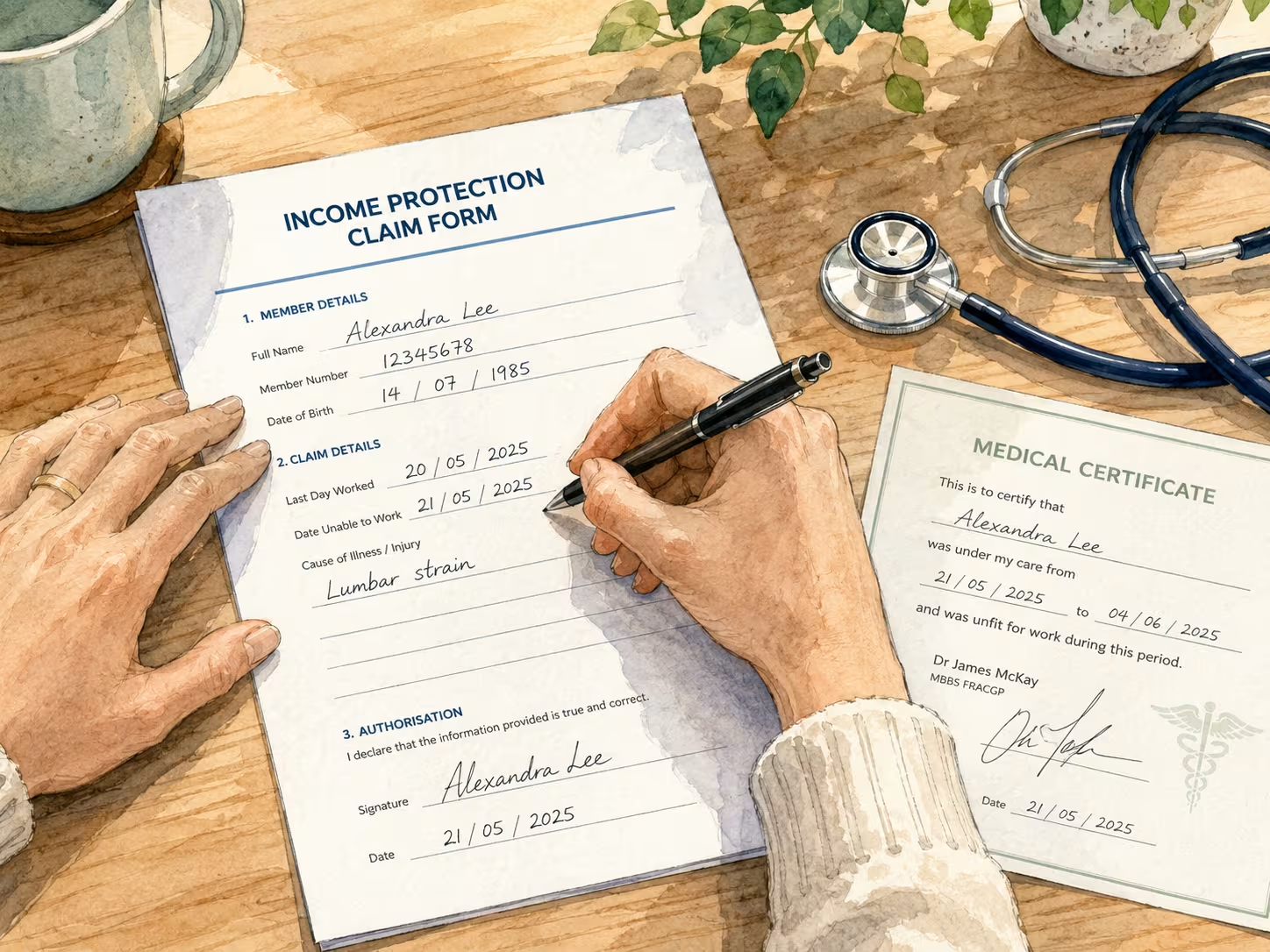
You should notify your employer as soon as possible and generally lodge your claim within six months of the injury, or of becoming aware of it, though the exact limit varies by state (Safe Work Australia, 2025). Notification and lodgement are two different things: telling your employer starts the clock and protects your position, while lodging the formal claim triggers the insurer's assessment.
The six-month window is the general rule, not a universal one. Most schemes allow claims outside that period where there is a reasonable explanation, for a disease that emerges slowly, or in cases of serious or latent injury such as an industrial illness that surfaces years later. But relying on an extension is risky.
In our experience helping readers navigate work injuries, the single most common mistake is delay: putting off the doctor's visit or the "official" notice because the injury seemed minor, or because the worker hoped it would settle. That gap is exactly where claims run into trouble. A late medical record makes it harder to link the injury to work, and a late notice gives the insurer room to dispute. Report the injury and see a doctor promptly, even if you think you will be fine in a week.Who Runs Workers' Compensation in Your State?
Each state and territory runs its own workers' compensation scheme, with its own regulator and insurer model, and Comcare covers many Commonwealth and licensed national employers (Safe Work Australia, 2025). This is the part general guides usually get wrong by only covering one state. Here is the full national picture in one place.
| Jurisdiction | Scheme / insurer | Regulator |
|---|---|---|
| NSW | icare (Nominal Insurer) | State Insurance Regulatory Authority (SIRA) |
| VIC | WorkSafe Victoria (WorkCover) | WorkSafe Victoria |
| QLD | WorkCover Queensland | Office of Industrial Relations / WHSQ |
| WA | Licensed insurers | WorkCover WA |
| SA | ReturnToWorkSA | ReturnToWorkSA |
| TAS | Licensed insurers | WorkSafe Tasmania |
| ACT | Private insurers | WorkSafe ACT |
| NT | Licensed insurers | NT WorkSafe |
| Federal | Comcare | Comcare / SRCC |
The models differ in ways that matter. Some states (NSW, VIC, QLD, SA) run a central or government insurer, while others (WA, TAS, ACT, NT) use privately licensed insurers your employer chooses. Whichever applies, your first point of contact is your employer's insurer, and your regulator is who you approach if something goes wrong. Always confirm the current details with your local regulator, because scheme arrangements change.
What Can You Claim For?
Schemes cover reasonable medical and rehabilitation costs, weekly payments to replace lost wages, and lump sums for permanent impairment (Safe Work Australia, 2025). Weekly payments are usually based on your pre-injury average weekly earnings (PIAWE), typically at a higher percentage for the first weeks and stepping down over time.
The main categories are:
- Medical and rehabilitation: doctors, hospital, physiotherapy, medication, and travel to treatment.
- Weekly payments: income support while you cannot work or can only work reduced hours, based on your pre-injury earnings.
- Permanent impairment lump sums: a one-off payment if the injury leaves lasting impairment above the scheme threshold.
- Return-to-work support: retraining, workplace modifications, and a suitable-duties plan to get you back safely.
The typical serious claim involved a median 7.4 weeks off work and a median compensation of around $16,300 in the most recent data (Safe Work Australia, 2025). But averages hide a wide range, and one category sits well above the rest.
What About Psychological and Stress Claims?
Mental health claims are a rising and distinct category, with a median 35.7 weeks off work and median compensation of $67,400, far higher than the physical-injury average (Safe Work Australia, 2025). A work-related psychological injury, whether from bullying, harassment, excessive workload, or a traumatic incident, is compensable in the same way as a physical one, but it plays out differently.
These claims take longer and are scrutinised harder. Some states apply a higher threshold, requiring that work be the main or a significant contributing factor, and exclude injuries arising from reasonable management action taken reasonably (such as a fair performance process). That makes evidence and timing especially important. If your psychological injury stems from how you were treated at work, you may have wider legal options alongside a workers' comp claim, including a general protections or unfair dismissal action.
What If Your Claim Is Rejected?
If an insurer disputes liability, you can request an internal review and then escalate to your state's dispute resolution body or tribunal, often with legal help (Safe Work Australia, 2025). A rejection is not the end of the road; disputed claims are resolved every day.
The pathway generally runs: ask the insurer for written reasons, request an internal review or reconsideration, then apply to the independent dispute body, for example the Personal Injury Commission in NSW, the Workers' Compensation Independent Review Service or Accident Compensation Conciliation Service in Victoria, or the equivalent tribunal in your state. Strict time limits apply at each stage, so move quickly. Many employment and personal injury lawyers offer a free first consultation and act on a no-win-no-fee basis for these disputes. Before you engage anyone, weigh the cost using our guide to how much a lawyer costs in Australia, then use the directory to find an independent lawyer in your state.
Frequently Asked Questions
How long do I have to claim workers' comp?
Notify your employer as soon as possible and generally lodge your claim within six months of the injury or of becoming aware of it, though the exact limit varies by state (Safe Work Australia, 2025). Many schemes allow later claims for a reasonable cause or for slow-developing diseases, but prompt action is always safer.
Who pays workers' compensation?
Your employer's workers' compensation insurer pays the claim under the relevant state scheme, not the employer directly (Safe Work Australia, 2025). Employers are legally required to hold this insurance, and in some states the insurer is a central body such as icare (NSW) or WorkCover Queensland.
Can I claim for a mental health injury?
Yes. Work-related psychological injuries are covered, though some states apply higher thresholds and exclude injuries from reasonable management action (Safe Work Australia, 2025). Mental health claims involve a median 35.7 weeks off work, so they typically take longer to resolve than physical-injury claims.
Do I need a lawyer to claim?
Not to lodge a standard claim, since the process is designed for workers to use directly. But legal advice helps if your claim is disputed, your injury is serious, or you are offered a lump sum settlement. Many lawyers act on a no-win-no-fee basis for workers' compensation disputes.
Are contractors covered?
Usually not as employees, though it depends on the arrangement. Genuine independent contractors generally fall outside workers' compensation, but some are "deemed" workers under certain schemes, and misclassified contractors may in fact be employees with full coverage. Your correct classification, not the label on your contract, decides whether you can claim.
Conclusion
A work injury is stressful enough without a confusing claims system on top of it. The process is navigable if you move early and know who handles your state. Key takeaways:
- The claim path is five steps: notify your employer, get a certificate of capacity, complete the form, lodge with the insurer, respond to the liability decision
- Notify as soon as possible and generally lodge within six months, because delay is the most common thing that weakens a valid claim
- Each state runs its own scheme with its own regulator and insurer; Comcare covers many federal employees
- You can claim medical costs, weekly payments and permanent impairment lump sums
- Mental health claims are covered but take far longer, a median 35.7 weeks off work
- A rejected claim can be reviewed and escalated to your state's dispute body, often with no-win-no-fee legal help
Report the injury, see a doctor, and lodge promptly. If your claim is disputed or your injury is serious, use the directory to find an independent employment or personal injury lawyer in your state before a deadline passes.
Dig deeper into your employment rights:
- Employment Law in Australia: Employee Rights Complete Guide
- Unfair Dismissal in Australia: How to Make a Claim
- Redundancy Pay in Australia: What You're Entitled To
Related guides: